.svg)


Understanding the Synergy Between Master Developers and Sub-Developers in Dubai


Dubai’s skyline is more than a feat of engineering; it is a meticulously regulated ecosystem. For investors, homeowners, and industry professionals, navigating this landscape requires understanding two pivotal roles: the Master Developer and the Sub-Developer. While often used interchangeably in casual conversation, their legal obligations, financial structures, and impacts on property value are distinct and complementary.
At Artha Realty, we believe that transparency is the foundation of a successful "journey to value. "Whether you are an institutional investor or a first-time buyer, understanding the hierarchy of development is essential for making informed decisions. This guide explores the technical roles, legal frameworks, and the strategic necessity of the master-developer model in Dubai.
1. Defining the Roles: The Macro vs. the Micro
In Dubai’s real estate terminology, the distinction between a Master Developer and a Developer (often referred to as a Sub-developer) is grounded in Law No. (6) of 2019 concerning the Ownership of Jointly Owned Real Property.
The Master Developer: The "Urban Architect"
A Master Developer is a licensed entity responsible for the large-scale planning and infrastructure of an entire district or community. They do not just build houses; they build "cities within a city." Their primary responsibility is the Master Project, which includes:
- Infrastructure: Roads, sewage, power grids, and telecommunications.
- Common Facilities: Public parks, lagoons, community centers, and street lighting.
- Governance: Setting the Master Community Declaration (MCD), which dictates the architectural guidelines and usage rules for the entire area
Examples: Emaar (Downtown Dubai), Nakheel (Palm Jumeirah), Dubai Holding (City Walk).
The Sub-Developer: The "Building Creator"
A Developer (Sub-developer) is an entity that purchases a specific plot of land from a Master Developer to construct a stand alone project—be it a high-rise tower, a cluster of villas, or a commercial complex. Their focus is "vertical":
- Design & Construction: Developing the specific building or cluster.
- Unit Sales: Selling individual units (apartments or villas) to end-users.
- Delivery: Ensuring the building meets the specific standards of both the Master Developer and RERA (Real Estate Regulatory Authority).
Examples: Ellington Properties, London Gate, or Sobha (when developing within a third-party master community).
2. The Relationship: A Web of Approvals and Governance
The relationship between these two entities is not just a land transaction; it is a long-term partnership governed by strict regulatory checkpoints.
The No Objection Certificate (NOC)Workflow
The NOC is the "connectivet issue" of Dubai real estate. A sub-developer cannot proceed with significant milestones without the Master Developer’s blessing.
- Design NOC: Before a sub-developer can break ground, their architectural plans must be approved by the Master Developer to ensure they align with the community's aesthetic and density rules.
- Sales/Transfer NOC: When an owner wants to sell a unit, the Master Developer must confirm via an E-NOC (Electronic NOC) that all community service charges are cleared.
The Master Community Declaration (MCD)
The MCD is a legal document registered with the Dubai Land Department (DLD). it acts as the "constitution" of the community. It defines the "Common Parts" (the building’s shared areas) versus the "Common Facilities" (the master community’s shared areas). It ensures that a sub-developer cannot suddenly build a factory in the middle of a luxury residential community.
The Mollak System: Financial Transparency
Under Law No. 6 of 2019, the management of service charges is handled through the Mollak system. Master Developers manage the "Master Community Service Charge" (for the parks and roads), while sub-developers (or their appointed management companies) handle the "Building Service Charge" (for the elevators and lobbies). Mollak ensures that every dirham paid by an owner is audited and used solely for the community’s upkeep.
3. Top Communities and Their Master Developers (2026 Overview)
The following table highlights the primary architects of Dubai’s most sought-after districts:
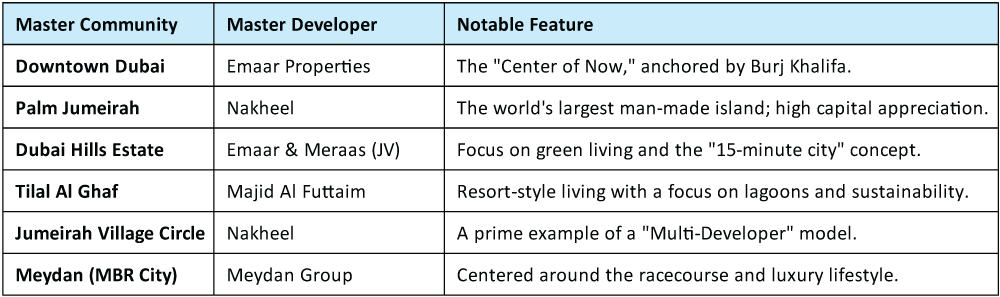
4. Legal Obligations and Safeguards
Dubai’s regulatory framework is designed to protect the "Investor's Journey." Key laws include:
- Law No. (7) of 2006 (Land Registration): Mandates that all property rights be registered with the DLD. This ensures that the master developer's title is clear before land is sold to a sub-developer.
- Law No. (8) of 2007 (Escrow Accounts): This is the gold standard for investor protection. Sub-developers must deposit all buyer payments into a project-specific escrow account. Funds are only released based on construction milestones verified by DLD-approved consultants.
- Law No. (13) of 2008 (Interim Register): Introduces Oqood, the interim registration for off-plan units. This prevents sub-developers from "double-selling" units and gives the buyer legal standing before the building is finished.
- Law No. (6) of 2019 (JOP Law): Clarifies that Master Developers are responsible for the "Macro" infrastructure and provides a mechanism for owners to have a voice through advisory committees.
5. Case Studies: Unified vs. Multi-Developer Models
Case Study A: The Unified Vision(Downtown Dubai)
In Downtown Dubai, Emaar acts as both the Master Developer and the primary Sub-developer.
- Result: High aesthetic consistency, perfectly synchronized infrastructure (e.g., the Dubai Trolley and walkway connections), and aggressive price protection.
- Client Benefit: Predictability. Buyers know exactly what the neighborhood will look like in 10 years, leading to a "brand premium" in resale value.
Case Study B: The Multi-Developer Model(Jumeirah Village Circle - JVC)
In JVC, Nakheel provided the master plan and infrastructure, but sold hundreds of plots to various sub-developers like Ellington, Binghatti, and smaller boutique firms.
- Result: A diverse range of architectural styles and price points. It allows for "entry-level" luxury and higher rental yields due to lower entry costs.
- Client Benefit: Choice and Yield. Investors can find high-quality boutique buildings that offer better ROI than more expensive master-branded projects.
6. How the Model Benefits the Client
The master-developer model is the engine of Dubai’s real estate stability. Here is why it matters for your portfolio:
- Controlled Supply: Master developers strategically phase land releases to prevent market saturation, which protects the capital appreciation of your property.
- Infrastructure Reliability: Because the Master Developer is often government-linked or a massive institutional entity, you are guaranteed that the roads, streetlights, and parks will be built—even if a specific building sub-developer faces delays.
- Long-term Maintenance: The MCD ensures that a neighborhood remains high-end. You won't find a neglected building ruining the "vibe" of a premium street because the Master Developer has the authority to enforce maintenance standards.
- Lifestyle Continuity: When you buy into a master community, you aren't just buying four walls; you are buying access to the "Master Plan"—the schools, the retail hubs, and the green spaces that define your daily life.
7. The Future: Dubai 2040 Urban Master Plan
The need for this model has never been greater. The Dubai 2040 Urban Master Plan aims to make Dubai the "best city in the world to live in" by focusing on five urban centers. This vision relies on Master Developers to:
- Increase green and recreational areas by 105%.
- Ensure 55% of the population lives within 800 meters of a mass transit station.
- Manage the growth of "sustainable urban units."
Without the Master Developer acting as a central coordinator, achieving these integrated sustainability goals would be impossible through fragmented development alone.
8. Conclusion: The Artha Advantage
At Artha Realty, our Developer360 service is designed to bridge the gap between these two worlds. We act as an extension of the developer’s team, ensuring that every project is not just a building, but a legacy that fits perfectly within Dubai’s master-planned future.
For the investor, we provide the technical due diligence to distinguish between a "branded" community and a" well-governed" one. Understanding the relationship between the master and sub-developer is the first step toward securing an asset that doesn't just look good on a brochure but performs in the market.
Official References & Legitimate Sources:
- Dubai Land Department (DLD) - Regulatory Framework
- Law No. (6) of 2019 Concerning Ownership of Jointly Owned Real Property
- Dubai Urban Master Plan 2040 Official Portal
- RERA - Real Estate Regulatory Agency Guidelines
- Mollak System - Dubai Land Department
For personalized consultation on your real estate assets or to explore our Developer 360 services, visit Artha Realty.
FAQs

.svg)